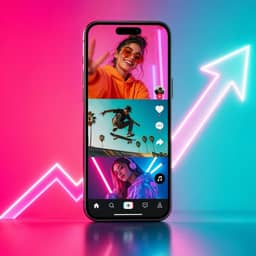
The fastest way for a brand to grow on Instagram Reels and YouTube Shorts is to stop chasing novelty. Find one format that shows your product working, pair it with audio that fits its rhythm, and publish variations of it over and over, changing one thing at a time. Treat each post as a test, reply to comments with new videos, and move the winners into your paid ads. It is a system, not a creative lottery.
Most brand accounts do the opposite. They post a different idea every day, judge each one on its own, and never learn which element drove a result. The playbook below is built from mechanics that hold on both platforms, plus the platform features that support each step.
Lesson 1: Find a format that only your product can fill
Generic UGC is crowded. Talking-head reviews, unboxings and day-in-my-life integrations are everywhere, and viewers have learned to swipe past them. What still works is content that shows the product's value in a way that feels native to how someone would come across it.
A good brand format passes two tests:
- It shows what the product does without feeling like an advertisement. A styling app swiping through outfits on a beat, a cleaning product on a visibly dirty surface, a budgeting tool turning a messy statement into a chart.
- It can be repeated dozens of times without going stale. The structure stays fixed and the example inside it changes: thirty different outfits, thirty different stains, thirty different statements.
This usually has to come from someone in-house who understands the product. Creators can execute a format well, but they rarely invent one that represents the product honestly, because they don't know which part of it people care about. Once the format exists, outsourcing works, as long as you give creators extremely specific examples to follow.
If you're stuck, borrow a structure that is already spreading and fit your product into it. The breakdown of how to turn a viral format into an ad concept covers how to read a format's anatomy before you adopt it.
Lesson 2: Treat audio as a strategic choice
Most accounts treat audio as an afterthought: pick something trending and move on. On Reels and Shorts, audio does more work than that. Both feeds are built to be watched with sound on, and the audio sets the rhythm the edit has to follow.
The approach that holds up:
- Match the beat to the content's natural rhythm. Swipe-throughs, reveals and cuts that land on the beat feel satisfying to watch. A track that fights the edit makes even good footage feel off.
- Reuse what works. Once an audio-visual pairing works, changing the track adds risk without adding information. Keep the audio fixed while you test the example, the hook or the length.
- Know what carries into ads. Organic Reels and Shorts give you access to music libraries that paid ads don't. Meta's Reels ad spec says licensed music isn't allowed in Reels ads (Meta Ads Guide), and Google tells Shorts advertisers to use royalty-free YouTube Audio Library tracks or clear the rights first (Google Ads Help). If you plan to put a winning post behind spend later, build it on original or library audio from day one.
Instagram lists audio as a factor too. Its ranking explainer names "information about the reel," including the audio track, among the signals it uses, and counts going to the audio page as one of the actions it predicts (Instagram, Adam Mosseri).
Lesson 3: Don't be precious with your content

Most people won't care. They're scrolling fast, and on Shorts they can leave any video with one swipe. Your content has to earn attention in the first second.
In practice:
Cut harder than feels comfortable. If a clip can be shorter, make it shorter, because every extra second is another place to lose someone. Shorts can run up to three minutes (YouTube Help), but the ceiling is not a target.
Double down on what works. When a video performs, don't celebrate and move on to something new. Make the same video again with a different example, then again. The people who saw your best video are a small slice of who could see it, and the next version reaches new viewers.
Kill your darlings. If the clever transition you spent an hour on doesn't hold attention, cut it. If a nuanced copy point can't get down to five words, drop it. Iteration speed matters more than the polish of any single video.
Test before you commit. Instagram's trial Reels feature shows a Reel to non-followers first. Around 24 hours after posting you can see its views, likes, comments and shares. Then you can share it with followers in one tap, or let Instagram share it automatically if it performs well in the first 72 hours (Instagram Creators). That lets you try a new variation without putting it in front of your whole audience.
The pattern-interrupt principle behind all of this is covered in why your first three seconds make or break everything.
Lesson 4: Use the comment section as a content engine
Replying to comments does more than keep a community happy. It gives you new videos to make and a direct line to people who are already interested.
- Reply with video, not just text. YouTube lets you reply to a comment with a Short; the commenter is notified, and the Short shows up in the comment feed below the original comment (YouTube Help). A question in the comments becomes the hook of your next video.
- Mine objections. Comments tell you what people doubt, misunderstand or want next, and each one is a script angle. The free AI ad copy generator turns those objections into draft copy you can test.
- Answer fast and personally. A thoughtful reply takes seconds, and a viewer who gets one now has a reason to visit your profile.
Lesson 5: Behave like a real account
Brand accounts often post and leave. They don't watch other videos in their niche, comment, or follow anyone. That costs them two things.
The first is research. If you don't watch your category, you won't notice the formats spreading through it. Your own feed is your cheapest trend report.
The second is relationships. Instagram's ranking explainer lists "your history of interacting with the person who posted" among the signals for what people see (Instagram), and YouTube says Shorts recommendations look at signals like what people watch and don't watch, their likes, and survey responses (Google Ads Help). An account that engages in its niche gives people more reasons to engage back.
Day to day, that means:
- Scroll your category's feed with intent, a few minutes at a time.
- Leave specific comments on creators in your space.
- Follow accounts you'd learn from.
- Collaborate with creators whose audience overlaps with your buyers.
Act like a creator trying to grow, not a brand account trying to extract value.
Turn organic winners into ads
The point of a repeatable format is that you know what works before you spend money on it. A format that has held attention organically across a dozen variations is a far safer bet for paid media than an untested concept.
On YouTube, Google's Shorts guidance recommends authentic creator assets and notes you can boost organic Shorts content through Brand Partner Access. Likes and comments on a Shorts ad also count on your original Short (Google Ads Help), so paid views and organic engagement end up on the same video. The YouTube Shorts ads guide covers campaign types and setup.
On Meta, take your best-performing structure into a Reels ad, rebuilt on original or library audio, with text kept inside Meta's safe zone: out of the top 14%, the bottom 35% and 6% on each side (Meta Ads Guide). The Instagram Reels ad specs has the full table, and Shorts hooks vs Reels hooks covers how to adjust the opener for each feed.
The system in one line

One format, the right audio, relentless repetition, real engagement, and an account that behaves like a person. None of it depends on a viral accident. Run the same test enough times to learn what works, then put money behind it.
FAQ
How often should a brand post on Reels and Shorts?
Often enough to learn something every week. The playbook depends on publishing several variations of one format so you can compare them, so consistent output matters more than any single post. Pick a cadence your team can sustain for months, not one you'll abandon after two weeks.
Should I post the same video on Reels and Shorts?
Yes, for most brands. Both are 9:16, sound-on feeds, so one master works on both. Strip any platform-specific references, avoid licensed music if the video may become an ad, and judge each platform on its own numbers. Audiences overlap only partly, so a video can win on one and not the other.
What is a trial reel on Instagram?
A trial Reel is shown to non-followers first. About 24 hours after posting you can see its views, likes, comments and shares. You can then share it with followers in one tap, or let Instagram share it automatically if it performs well in its first 72 hours. It lets you test a variation without risking your main feed.
Do I need to use trending audio to grow?
No. Audio that fits your format's rhythm matters more than whether it is trending. If you plan to turn a post into an ad, use original or library audio from the start, since Meta doesn't allow licensed music in Reels ads and Google asks Shorts advertisers to clear music rights.
How do I turn an organic Short or reel into an ad?
Take the version that held attention best, rebuild it on audio you're allowed to use in ads, check the text sits inside each platform's safe zone, and run it against your current best ad. On YouTube you can also boost organic Shorts through Brand Partner Access.
Find your format faster
You don't need to invent a format from scratch. Start with structures that already hold attention: browse the ad hook bank for openers to build around, pull concepts from the free AI video ad prompts, and study how winning ads open in the ad teardowns.
The AI Ad-Making Kit
$99Make hyperreal AI video and image ads for any brand, with free AI tools. No camera, no agency.
- 10 modules
- 300+ hooks
- 500+ prompts
Canva ad templates, free.
Proven D2C ad layouts. Swap in your product, export, launch.
Browse templates →Want to act on what you just read?
Browse 3,400+ free, Canva-ready ad templates sorted by industry. One click to open, five minutes to customise.
Browse Free Templates