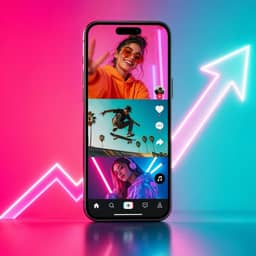
A viral format is a repeatable structure, not a single video: the same hook device, reveal pattern and visual template used by unrelated creators on unrelated topics. To turn one into an ad, strip it to that skeleton, swap in your product's proof, rebuild the audio with tracks you're allowed to use in ads, and test it as a new hook against your current control. Do it while the format is still spreading on Reels and Shorts, not once it has settled into the paid feed.
The opportunity is timing. Viewers already know how to watch a familiar format, which makes the first three seconds easier, and those seconds decide everything else. Once the same structure shows up in five competitors' ads, the advantage is gone.
What counts as a format (and what doesn't)
A trend is a topic people are talking about. A sound is an audio clip people are reusing. A format is the structure underneath. Of the three, only a format transfers cleanly into advertising, because you can keep the structure and change everything else.
Here is the test. Describe the video without naming its subject ("text-message screenshot, slow scroll, punchline in the last bubble"). If that description fits three or more unrelated creators, it's a format. If it only works with a specific celebrity, song or news event, it's a trend, and trends rarely survive the trip into a paid ad.
Anatomy of a viral short-form format
Every format worth stealing has the same six parts. Write them down for any format you are considering before you brief a single asset.
- Part — What to note — Why it matters for an ad
- Hook device — The first-second element: a fake notification, a question on screen, a visual mid-action — This is what you keep almost unchanged. It is the reason the format stops the scroll
- Promise — The question the hook plants in the viewer's head — Your product has to be the honest answer to it, or the format feels like bait
- Structure — Reveal, list, transformation, comparison, story — Decides where your proof goes
- Visual template — Screen recording, selfie cam, split screen, text-on-background — Tells you what you can produce cheaply, including with AI tools
- Audio role — Voice-led, music-timed cuts, silent with captions — Determines how you rebuild it without licensed tracks
- Payoff — What the last two seconds deliver — In an ad, the payoff and the CTA must be the same moment
The second column matters most. A format built on a curiosity gap only works in an ad if the gap closes on your product. If the payoff is a joke and your product is a footnote, the format sells the joke.
Where to spot formats on reels and Shorts before they peak

Format discovery is a habit. Thirty deliberate minutes a few times a week beats hours of passive scrolling.
Instagram's professional dashboard is the first place to look. Professional accounts can open it, go to "Your tools" and select Inspiration, which shows "reels that are similar to your content, popular with your followers, and suggested for you," along with trending audio, according to Buffer's walkthrough. Use it to see which structures are spreading in your niche, not to copy individual Reels.
YouTube Studio's Trends tab is the second. Under Analytics, it has a "Breakout videos" card that highlights well-performing content from creators similar to your channel, and a "Content gaps for Shorts" card showing Shorts searches where viewers can't find enough good results (YouTube Help). Breakout videos tell you which structures are working. Content gaps tell you which ones nobody has applied to your category yet.
A clean research account helps too. Your main feed is trained on your habits, while an account that only watches your category shows you something closer to your buyer's feed.
Then there's the Meta Ad Library. Once a format starts appearing in paid ads, competitors are already testing it. Check how long those ads have been running, since longevity is the closest public signal that a version is converting. The guide to what the Meta Ads Library will and won't show you covers how to read it, and the Meta Ad Library downloader saves the creative for your swipe file.
A format is still early when several small accounts are using it at once, comments ask "how did you make this," and no brands are in the mix yet. It is late when you see it in three ads in one session.
How to turn a format into an ad concept
Here is the five-step translation from organic format to testable ad.
- Write the skeleton. Fill in the anatomy table above and delete the original subject entirely. If the skeleton stops making sense without the original creator's personality or topic, it isn't a format you can borrow.
- Map your proof onto the payoff. Find the moment in your product story that answers the hook's question: a before/after, a result on screen, a price reveal. If nothing fits, drop the format. The before/after hook format is the cleanest example of a structure where the payoff is the proof.
- Rebuild the audio. Organic formats often ride a licensed track you can't use in paid media. Meta's Reels ad spec says licensed music isn't allowed in Reels ads and points to original audio or its sound collection instead (Meta Ads Guide). For Shorts ads, Google says to use royalty-free YouTube Audio Library tracks or clear the rights first (Google Ads Help). Recreate the timing and the beat drops, not the song.
- Keep the first two seconds intact. The hook device is what viewers recognise, and changing it removes the reason the format works. Your branding goes after the hook, not in the first frame.
- Test it as a hook, not a campaign. Run the format version as one new opener against your current winning ad body, judged on hold rate and cost per result. If it wins, it becomes the control. If it loses, you spent one test slot, not a production budget.
Build the master once in 9:16 and it serves both feeds. Shorts vs Reels: what transfers covers the small export and safe-zone changes, and Story and Reels ads covers how Meta's two vertical placements differ.
Formats that tend to translate well into ads
Structures that carry a product naturally: transformation reveals (the payoff is the result), screen-recording walkthroughs (the product is on screen throughout), text-message or notification hooks (cheap and recognisable), list or ranking formats (your product is one honest entry), and reaction or remix structures, which borrow credibility from a real response. That last group is why faceless creator ads and native organic-style ads keep showing up in the paid feed.
Formats built on mocking a person, an in-joke, or a dance with no story usually fail in ads, because attention lands on the bit and not on the product. For the paid-side view of which ad structures are currently spreading, see how to spot winning ad formats before they saturate.
Speed matters more than polish
Once a format works, competitors copy it and it starts to read as an ad, which is when it stops working as a hook. Whoever ships the first acceptable version gets the advantage. AI production helps here, since a test built from an AI actor, a screen recording and original audio can go live the same day. The six-step AI video ad workflow covers how.
FAQ

What is a viral video format?
A viral video format is a repeatable structure, such as a hook device, a reveal pattern and a visual template, that many unrelated creators use on different topics. Unlike a trend or a sound, the structure survives when you change the subject, so it can be rebuilt as an ad for your own product.
How do I find trending formats on Instagram reels?
Use the Inspiration section in Instagram's professional dashboard, keep a separate research account that only watches your category, and look for structures that three or more unrelated creators are using. Then check the Meta Ad Library to see whether brands already run the same structure in paid ads.
How do I find trending formats on YouTube Shorts?
YouTube Studio's Trends tab, under Analytics, shows breakout videos from creators similar to your channel, plus content gaps for Shorts, where viewers search but find few good results. Breakout videos show which structures work. Content gaps show topics nobody has applied them to yet.
How fast should I move on a new format?
Fast enough to test it while it is still mostly organic. Once the same structure shows up in several competitor ads, it reads as an ad and loses its hook advantage. Treat a format as one hook test against your control, so being wrong stays cheap.
Start with a hook that already works
A format gives you the structure, but you still need an opener that fits your product. Browse the ad hook bank for first lines that match the format you've found, or generate a batch of variations with the free AI hook generator and test the best three this week.
The AI Ad-Making Kit
$99Make hyperreal AI video and image ads for any brand, with free AI tools. No camera, no agency.
- 10 modules
- 300+ hooks
- 500+ prompts
Canva ad templates, free.
Proven D2C ad layouts. Swap in your product, export, launch.
Browse templates →Want to act on what you just read?
Browse 3,400+ free, Canva-ready ad templates sorted by industry. One click to open, five minutes to customise.
Browse Free Templates