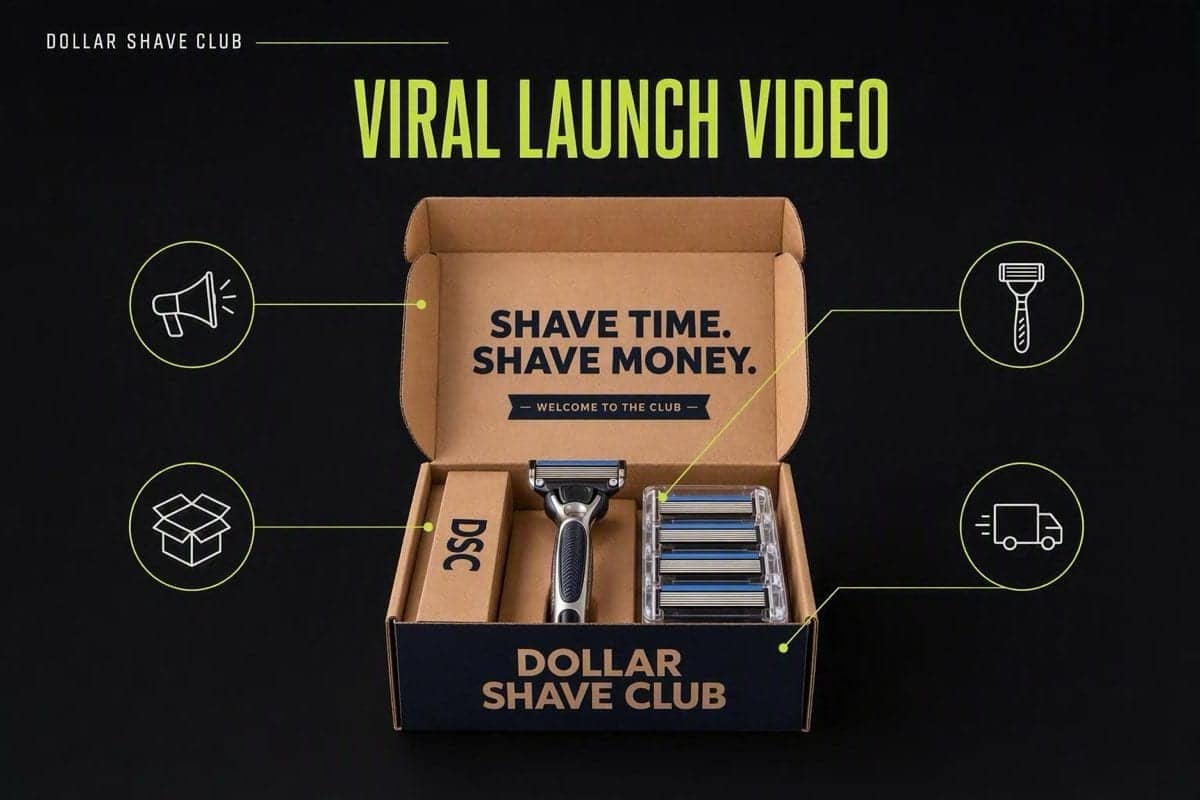
Dollar Shave Club launched on March 6, 2012 with a video that cost $4,500 to make. About 12,000 people signed up in the first 48 hours. Eight months later the company raised a $9.8 million Series A, and four years after launch Unilever agreed to buy a business with 3.2 million members and $152 million in 2015 turnover, for a price Fortune reported as $1 billion in cash. The video did not build that business alone, but the money, the press and the first customers all came from it.
This case study covers the business outcome. For the shot-by-shot creative mechanics, see our Dollar Shave Club teardown.
The problem: a commodity product against two giants
Razors were a category owned by incumbents with huge TV budgets. Dollar Shave Club's offer was simple and hard to make interesting: razors by mail, with plans starting at $1 a month plus $2 shipping, according to TechCrunch's launch-day coverage. The company had no retail shelf and no brand recognition. On launch day it had about $1 million of seed money led by Kleiner Perkins and Forerunner Ventures.
A subscription razor is a low-interest purchase. Nobody wakes up wanting to think about blades. The launch had to hold people's attention on a boring decision long enough for them to switch.
What they ran
One 90-second YouTube video, "Our Blades Are F***ing Great," starring founder Michael Dubin. Entrepreneur reported that it cost $4,500. Lucia Aniello, a comedian Dubin knew from the Upright Citizens Brigade, directed it and estimated that a comparable polished video would cost most companies about $50,000. Dubin's original script ran four pages, and Aniello cut everything that was not essential.
The release was a press event as much as an ad. Entrepreneur's 2017 profile says Dubin published it at 6 a.m. Pacific on March 6, 2012, announced the $1 million seed round alongside it, and timed it just before South by Southwest, when tech reporters were hunting for stories. In his words, "the tech press picked it up first, and then the mainstream press picked it up from there."
The documented results

- When — What happened — Source
- First 48 hours — About 12,000 sign-ups — Entrepreneur, Oct 2012
- First 3 months — 4.75 million YouTube views — Entrepreneur, Oct 2012
- Nov 2012 — $9.8M Series A led by Venrock, launch in Canada, 7M+ views — TechCrunch
- 2012 — $6 million in revenue — Entrepreneur, 2017
- Sep 2013 — About 300,000 subscribers — AdExchanger
- Sep 2015 — Claimed 2.2 million subscribers — Fortune
- Jul 2016 — 3.2 million members, $152M 2015 turnover, Unilever deal — Business Wire release
Two details matter when you read that table. First, sources disagree slightly on the first number: the 2012 Entrepreneur piece says 12,000 people signed up in 48 hours, while the 2017 profile says 12,000 orders came in on launch day. Either way, a $4,500 video produced a first cohort of five figures. Second, Unilever never disclosed the price. The $1 billion figure is Fortune's report, citing sources, carried by CNN Wire.
What the video actually did for the company
It bought the first customers at almost no cost. A five-figure subscriber base in two days gave the company recurring revenue to show investors before it had spent much on media.
It strengthened the fundraising story. The seed round and the video went out the same morning. Eight months later the Series A announcement still led with the view count, and Dubin called the video "a really great asset for us".
It set the brand voice for years. The deadpan, slightly profane founder tone became the house style for everything that followed, so later ads were recognisable before the logo appeared.
It made a boring category newsworthy. Press coverage was the distribution. A razor subscription is not a story, but a founder roasting the razor industry for $4,500 is.
Why it worked
- The offer was better. A dollar a month against drugstore cartridge prices is a real saving. The comedy got the attention, and the price closed the sale.
- The founder was the product demo. There were no beauty shots and no feature list, just a confident person explaining a simple deal that a viewer could judge in seconds.
- The launch was built for press. Funding news, a festival week and a shareable video landed together, so every outlet had a reason to cover it the same day.
- It was cheap enough to risk. At $4,500, a flop would have cost almost nothing, so the team could make something an agency client would never approve.
What did not carry the business
The viral video was the start, not the growth engine. By September 2013, Dubin told AdExchanger that paid media had become the bigger driver: "Right now I would say paid is more significant, as it drives a larger share of return." His long-term goal was a 50/50 split.
The spend got large. Fortune, citing iSpot.tv, reported that Dollar Shave Club spent $64.5 million on TV ads between November 2014 and September 2015, more than Gillette over the same period, and that the company was not yet profitable even as subscribers doubled.
The ending is less tidy than the headline. In October 2023, Unilever sold a majority stake to private equity firm Nexus Capital, keeping 35%, with financial terms undisclosed. A great launch ad buys a beginning, but it says little about the economics of a subscription business years later.
What to steal for your Meta, Instagram and YouTube ads

- Put the offer in the first sentence. "For a dollar a month, we send razors to your door" works as a cold open on Reels and Shorts because it answers "what is this?" before the scroll. Write five versions of your offer as a single spoken line, then pick the plainest. Our hook bank has openers sorted by angle if you need a starting point.
- Let a founder or real employee carry one video. Shoot it on a phone in your workspace. Test it against your polished creative as a separate ad set, with the same budget and audience, for at least a week.
- Use humour that attacks the category, not the customer. Dubin mocked overpriced razors, never the people buying them. If your joke makes the viewer feel stupid, cut it. The meme-style ad trend works for the same reason when it is aimed at a shared annoyance.
- Stack the launch. Release your hero video on the same day as something reporters care about: a funding round, a price cut, a data point. Pitch the video as the story.
- Plan the paid engine early. Treat the organic hit as your first creative winner, then cut it into 15-second and 30-second paid versions. Dollar Shave Club's own history says the paid side ends up doing more of the work.
For more on why the first three seconds decide whether any of this gets watched, read the pattern interrupt guide.
Sources
- TechCrunch, Dollar Shave Club launches, raises $1M (March 6, 2012)
- Entrepreneur, How a Dollar Shave Club's ad went viral (October 2012)
- TechCrunch, Dollar Shave Club raises $9.8M, launches in Canada (November 1, 2012)
- AdExchanger, Dubin on paid media vs viral video (September 16, 2013)
- Fortune, Dollar Shave Club claims it passed Schick (September 8, 2015)
- Business Wire release via El Diario NY, Unilever acquires Dollar Shave Club (July 2016)
- CNN Wire via WTKR, Unilever to buy Dollar Shave Club for reported $1 billion (July 20, 2016)
- Entrepreneur, How Dollar Shave Club's founder built a $1 billion company (March 28, 2017)
- Personal Care Insights, Unilever offloads Dollar Shave Club (October 26, 2023)
Want an opener that does what Dubin's first line did? Pull one from the free HookAds hook bank, or browse more brand breakdowns in the case studies library.

The AI Ad-Making Kit
$99Make hyperreal AI video and image ads for any brand, with free AI tools. No camera, no agency.
- 10 modules
- 300+ hooks
- 500+ prompts
Canva ad templates, free.
Proven D2C ad layouts. Swap in your product, export, launch.
Browse templates →Want to act on what you just read?
Browse 3,400+ free, Canva-ready ad templates sorted by industry. One click to open, five minutes to customise.
Browse Free Templates