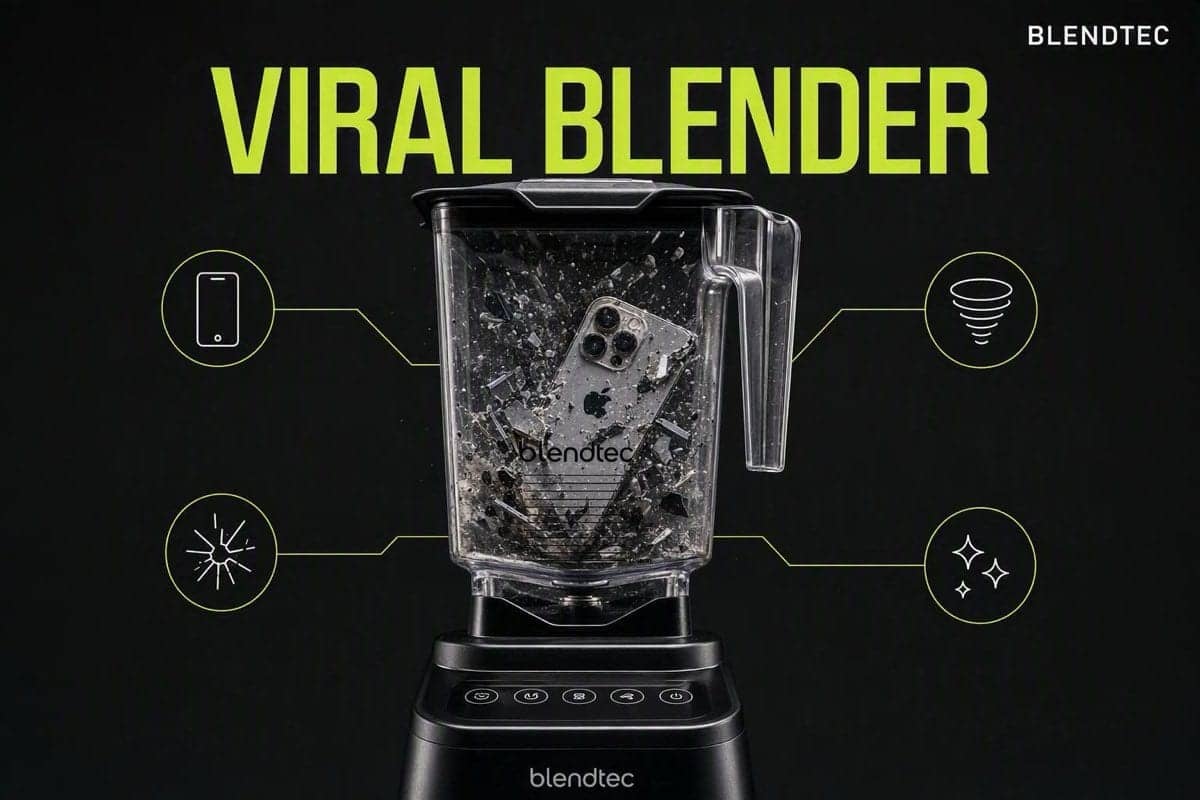
Blendtec's "Will It Blend?" began in October 2006 when marketing director George Wright spent $50 on a lab coat, marbles, a rake and a fast-food meal, then filmed founder Tom Dickson blending them. Dickson said the videos got 6 million hits in the first week. By 2008, Wright was telling marketing conferences the series had pushed blender sales up 700%, a figure Blendtec reported but never backed with dollar numbers. It remains the cleanest example of a product demo doubling as entertainment.
The problem: a strong product nobody had heard of
Blendtec, a food-processing appliance maker in Orem, Utah, sold to both commercial kitchens and households. Consumers had no reason to know the name. Wright summed it up at PubCon 2008 as "Great products + weak branding = weak sales", according to Search Engine Roundtable's write-up of his keynote.
The idea came from the factory floor. BYU's alumni magazine reports that soon after Wright joined, he noticed sawdust and wood shavings around the plant: Dickson routinely tested blenders by jamming 2x2 boards into them at full speed. "I realized that with the right marketing," Wright told the magazine, "we could make millions aware of this powerful blender."
What they ran

A short web series with one rule: put something absurd in the jar, ask "Will it blend?", and let the result answer. Wright's $50 shopping list was a lab coat, marbles, a rake, a six-pack of soda, a fast-food value meal and golf balls. The marbles became glassy dust and the rake handle a pile of slivers.
The early tone was flat on purpose. The person who filmed the first episodes wrote on Blendtec's own blog that Dickson used "almost no comedy, no lines, no gags or sound effects." The first video posted was marbles, introduced with roughly one sentence: "Here are some marbles; I think we'll blend these."
Distribution was split by job. In 2007, Blendtec's national sales manager Dan Grover told USA Today, "We're on YouTube to get the audience and Revver to get the money". Revver, a video site that shared ad revenue, had paid Blendtec about $15,000 for clips including blended iPhones, lighters and a whole chicken.
The format also took requests. Wright said at PubCon that viewer suggestions shaped future episodes, and fans who saw their idea used became promoters.
The documented results
- Claim — Who said it, where
- 6 million hits in the first week — Tom Dickson, BYU Magazine, 2009
- About $15,000 in Revver revenue share — USA Today, September 2007
- "A $50 investment resulted in a 700 percent increase in blender sales" — George Wright, as reported by ClickZ, September 2008
- 65M YouTube views, 120M on WillItBlend.com, 200,000+ subscribers, total blender sales up 700% — Wright's PubCon keynote, Search Engine Roundtable, November 2008
- "Within two years, the campaign helped increase retail blender sales 700 percent" — BYU Magazine, Spring 2009
Wright also described a pull-through effect: consumer fame helped Blendtec's commercial business because restaurant buyers now knew the name.
Why it worked
- The product was the entertainment. There was no gap between the ad and the demo. Watching the blender destroy something was the whole show, and every episode made the same claim: this motor is absurdly strong.
- If it turns an iPhone to powder, your frozen fruit is not a problem. The extreme case made the everyday use obvious without anyone saying it.
- "Will it blend?" was a template, not a single spot. Every new object was a new episode, which is why the series ran for years instead of peaking once.
- Blendtec used a real person, not an actor. Wright's advice at PubCon was to use people comfortable being themselves, and Dickson was the founder doing what he already did in testing.
- News hooks were built in. Blending the hot gadget of the moment meant every big product launch handed Blendtec a new episode people were already searching for.
Limits and honest caveats
The 700% is a company figure without a baseline. Wright never disclosed the dollar change, as ClickZ noted. A 700% lift on a small consumer business is impressive, but it says nothing about absolute revenue, and no independent audit exists.
The number moved. The same November 2008 write-up of Wright's keynote opens by saying sales rose over 500%, then lists 700% in his results. BYU frames it as retail sales over two years. Treat it as "Blendtec reported a several-fold increase in consumer sales," not as a precise metric.
Accuracy got checked in public. Wright told the PubCon audience that viewers called Blendtec out for using ceramic magnets instead of neodymium magnets in one episode. When the demo is the claim, mistakes in the demo become public fast.
It was 2006. YouTube was new and attention was cheap. The series ran until 2020, according to Wikipedia. A stunt-demo channel launched today competes with far more content.
What to steal for your Meta, Instagram and YouTube ads

- Find your 2x2 board. Ask your product or ops team what torture tests they already run. The best demo is often something staff do every week without thinking it is interesting.
- Push the demo past the use case. Show the extreme version (the iPhone, not the smoothie) in the first two seconds, then let the viewer infer the everyday benefit. This works especially well as a before-and-after hook.
- Turn it into a format with a question in the title. A repeatable question ("Will it...?", "Can it survive...?") gives you a series of Reels and Shorts instead of one ad, and gives fatigue-hit campaigns a fresh variant every week.
- Shoot it plainly. One person, one take, no music bed. Native, unpolished demos tend to read as content rather than ads, which is the point of the native organic-style trend.
- Let comments write the next episode. Pin a comment asking what to test next, then credit the commenter. It is free ideation and free distribution.
If you want more proof-led formats to adapt, the UGC ads format guide covers how to brief creators on demonstrations.
Sources
- USA Today, Posters reap cash rewards at video-sharing site Revver (September 2007)
- ClickZ, Mashup: 200 PR execs, one blender (September 12, 2008)
- Search Engine Roundtable, Keynote address by George Wright of Blendtec (November 12, 2008)
- BYU Magazine, Will It Blend? (Spring 2009)
- Blendtec, The story behind "Will It Blend?" (December 2012)
- Wikipedia, Will It Blend? (series dates only)
Need a first line that sets up your own torture test? Generate options with the free AI hook generator, or see more documented campaigns in the case studies library.
The AI Ad-Making Kit
$99Make hyperreal AI video and image ads for any brand, with free AI tools. No camera, no agency.
- 10 modules
- 300+ hooks
- 500+ prompts
Canva ad templates, free.
Proven D2C ad layouts. Swap in your product, export, launch.
Browse templates →Want to act on what you just read?
Browse 3,400+ free, Canva-ready ad templates sorted by industry. One click to open, five minutes to customise.
Browse Free Templates